Tuesday, November 21, 2006

Craft Show

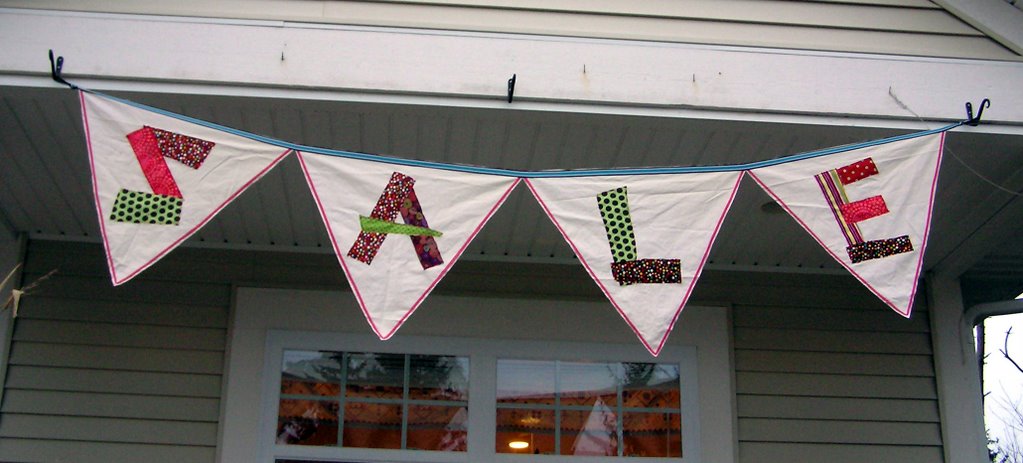
Last weekend I participated in a craft show. It was with friends, and friends of friends, in one of their houses.

There were chocolate toffees made with Callebaut; beaded jewelry and bookmarks; clothing sewn from vintage and reproduction fabrics; knitted and crocheted clothing and purses; jams, jellies, and salsas; silk floral arrangements; cold-process soaps, balms, and herbal wraps; framed photographs; felted purses made from recycled sweaters; and my rag dolls.
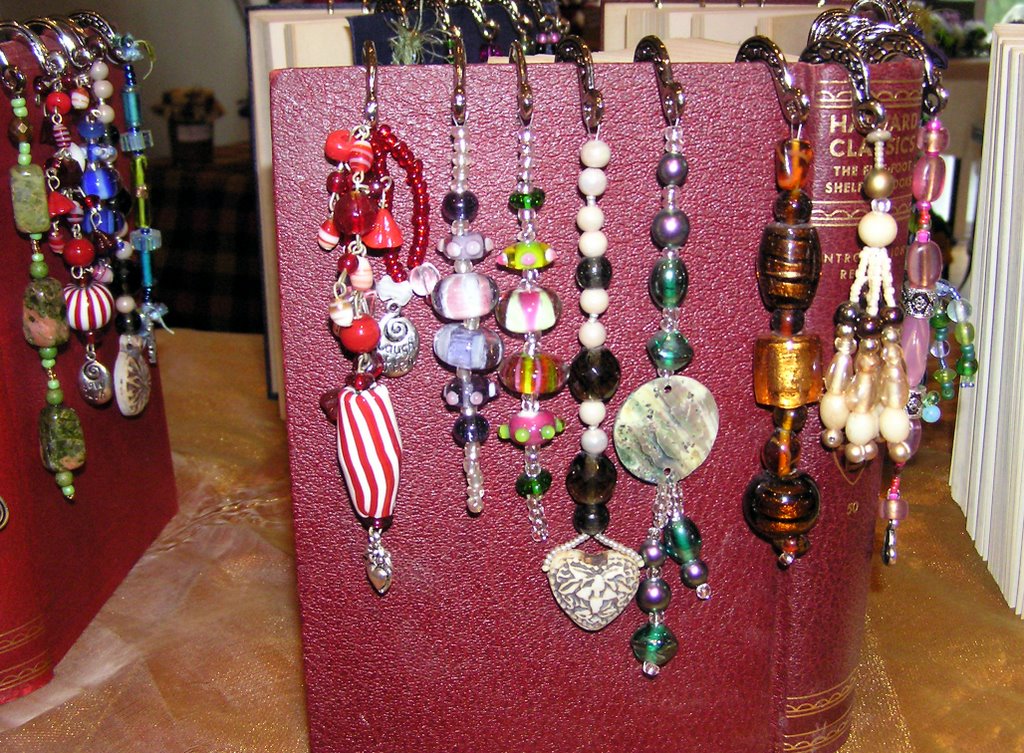
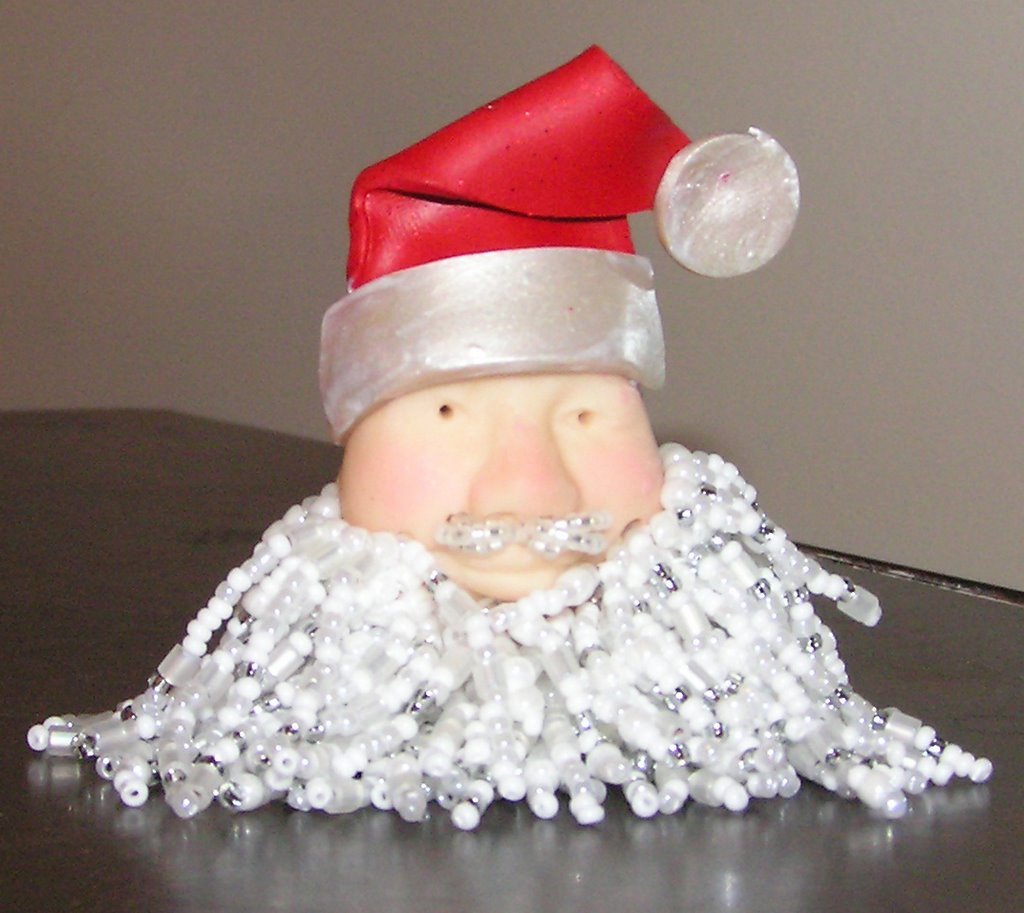
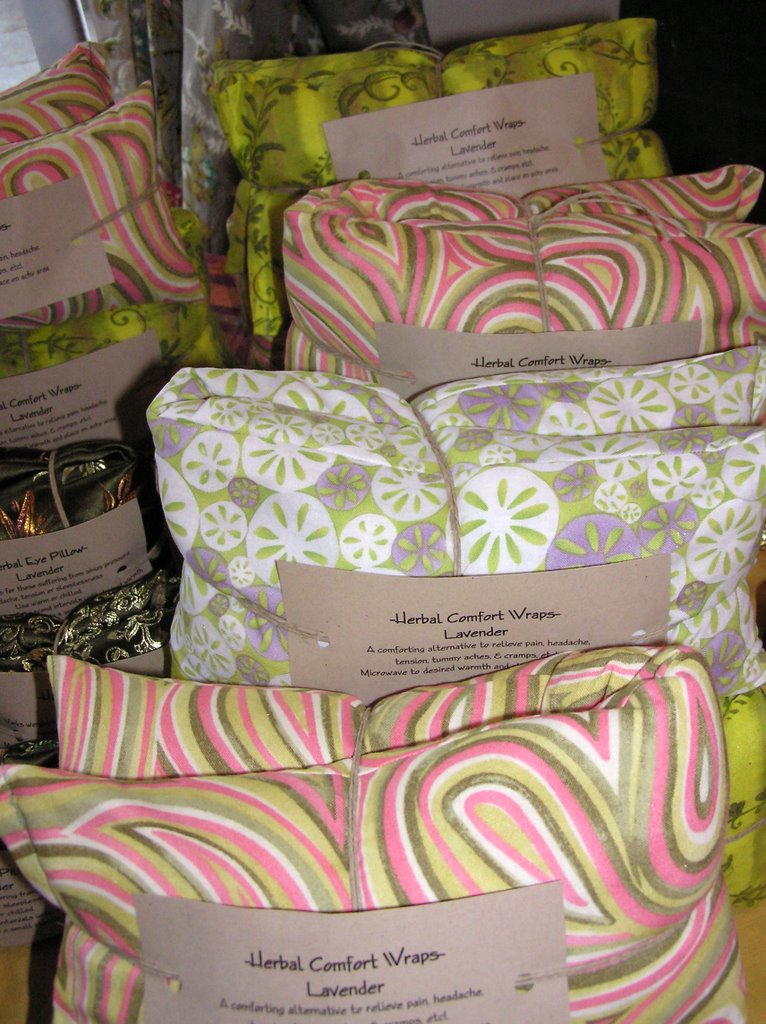
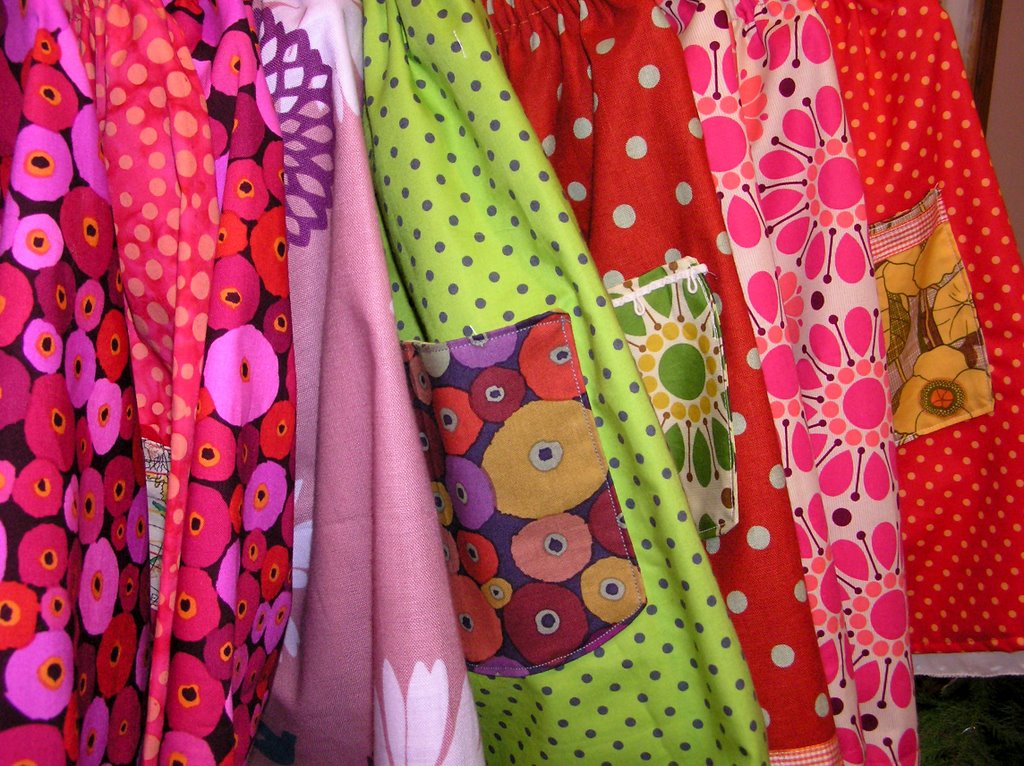

It was a really interesting experience. It was enlightening seeing what appealed to people, although in the end I could reach no coherent conclusions. Big-ticket items, for example, were very poor sellers, except for the recycled-sweater purses, which sold like hotcakes at $65. A handknit sweater, on the other hand, wouldn't leave the rack at $45.

Likewise inconsistent were items with obvious eye appeal. The floral arrangements were, at least to me, the most obviously visually appealing items on display, and they sold very well. Yet some of the prettiest among them were unsold at the end of the day (and not the highest priced, either).

One crafter noted that the lowest-priced items always sell well. I didn't find this to be overwhelmingly the case. The soaps and balms, for instance, sold steadily over the course of the day, but I would have expected far more customers to buy a bar or two. The candies seemed to sell well, but I didn't see a lot of movement on the lower-priced jams and jellies.
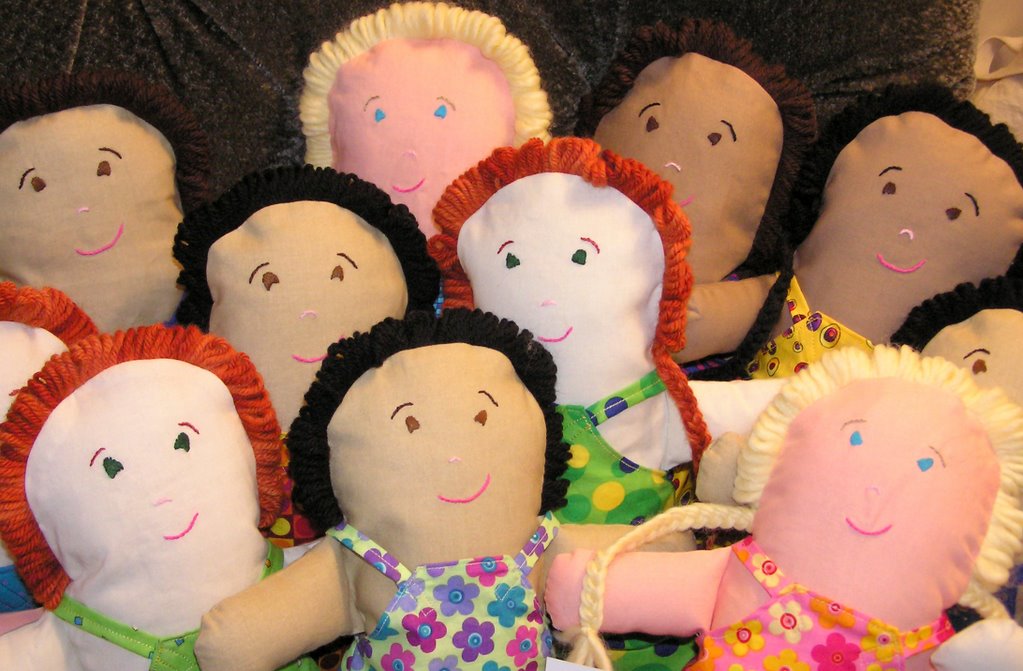
My dolls were nearly universally ignored by grown-ups and loved by children. Seeing kids' eyes light up when they saw the dolls made my day. That was my audience, and I had a solid score. One child in particular, probably just shy of two, was a picture. Her eyes went wide and her jaw dropped when she saw the dolls. She made a beeline for one of them and hugged it closely, a look of bliss on her face. She then set it on the couch and leaned her face on it, settling into its comfort. She played with several of the dolls, hugging each one, but never let go of the first one. I didn't notice when she and her mother left, emptyhanded, in a bustle of customers, but I was heartbroken. I would happily have given that child the doll as she loved it so.

I did sell some dolls, not many. At the end of the day the crafters purchased and traded amongst ourselves, and I was happy to barter dolls for some of their goodies that I could not have afforded to buy. I also gave dolls to the two children of the house and to the child of one of the crafters. This little girl had a very successful day selling her beaded bracelets -- I think she was the most successful crafter there in terms of items sold.

Moneywise, I came out almost even, probably a tad in the red. But I had fun and got to spend time with some friends. I learned that I loved my little dolls and felt funny selling them. What made me happiest was giving them away.

Thursday, November 16, 2006

Not What You Think

So . . . what do you think?

Monday, October 30, 2006

Going All Medieval

At middle school, my sixth-grade daughter took an exploratory class in medieval history. This fit in nicely with the book they're reading in language arts, Crispin: The Cross of Leadby Avi, which is set in the Middle Ages. (I used to live in Avi's attic. How weird is that?)
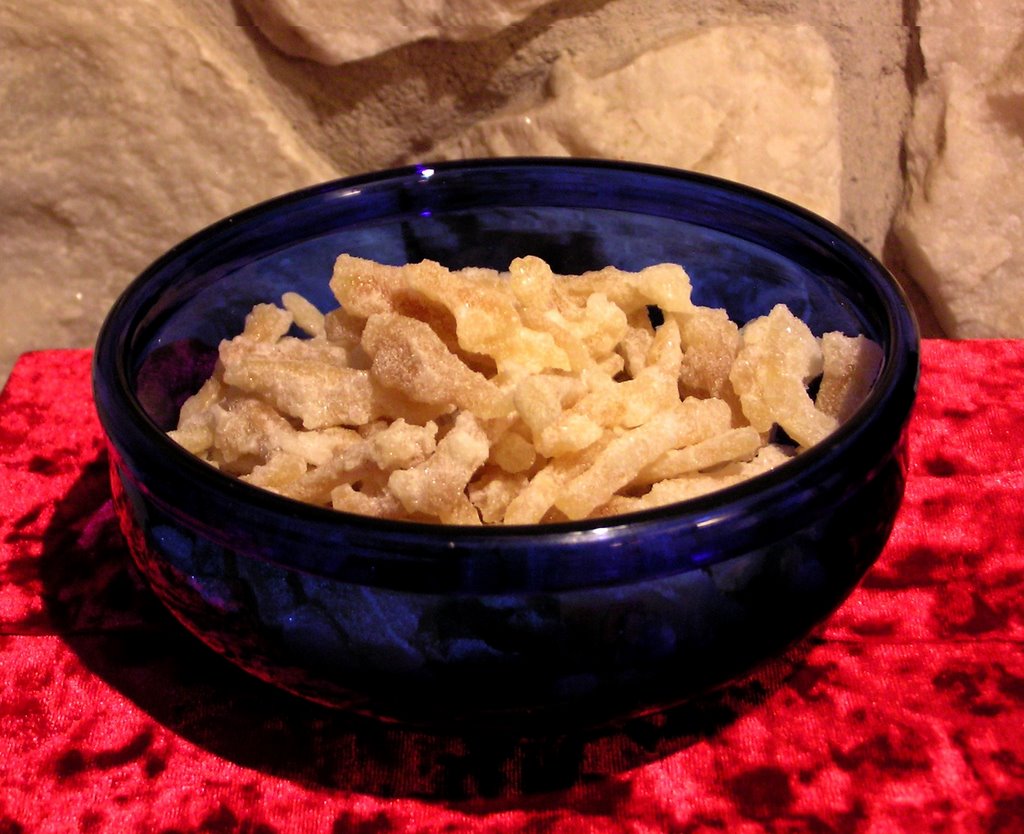
In class, the students worked in small groups to research different aspects of medieval life. Madaleine's group studied food. They made a nice poster detailing typical meals for nobles and peasants and set up a table with food models -- a plastic loaf of bread, crumpled purple paper grapes, a rubber chicken. All very well and good. But Madaleine decided, on her own, to find a recipe for and make a read medieval dish. What she chose was candied horseradish from a fourteenth century treatise on candymaking, Libre de Totes Maneres de Confits, translated from the Catalan by Vincent Cuenca and available on the Medieval Cookery website.

What a taste sensation! Candied horseradish is to modern candy what lapsang souchong is to tea: smoky. It doesn't have the sinus-clearing bite of fresh horseradish, but the heat remains in a taste reminiscent of campfires. (I can just imagine the castle cook looking at yet another knobby horseradish root and thinking, "What the hell am I going to make with it this time?" and then yelling at the scullery maid who knocked it into the vat of honey. "You got chocolate in my peanut butter!" "No, you got peanut butter in my chocolate!" Wait, wrong century.)

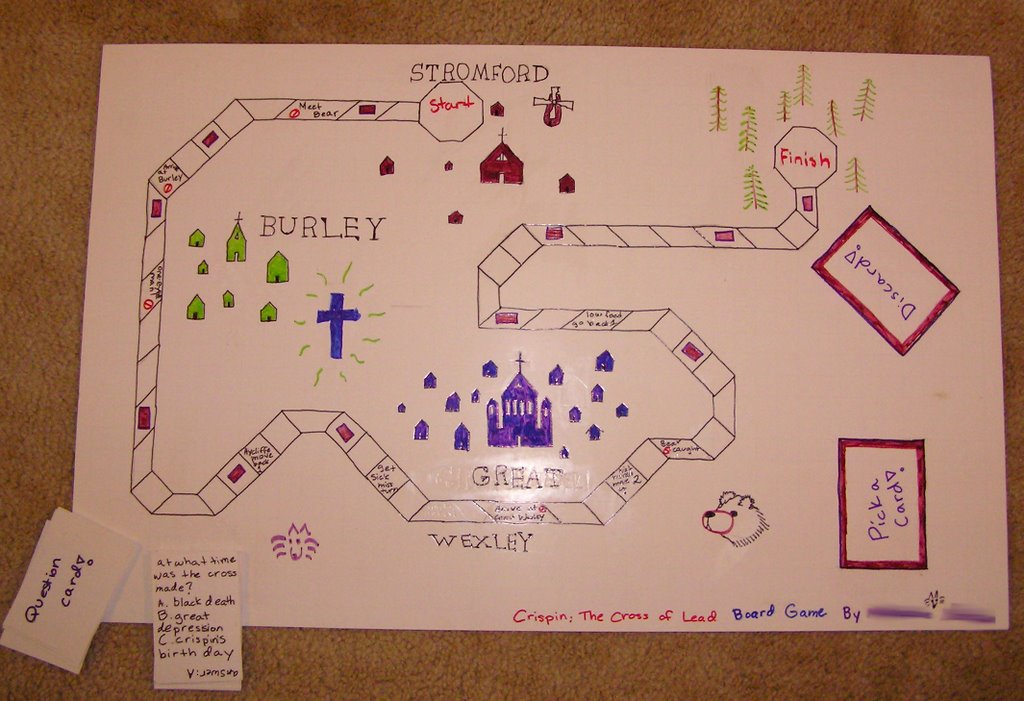
Tonight my daughter finished an extra credit project, making a board game out of Crispin. It was so much fun to watch her work. And here it is. Wanna play?

Friday, October 27, 2006

Slide Show Application


Another ultra-cool free doodad, slide shows. Lots of styles, loads of fun. This one hooked right up to my flickr account. And best of all, it's free. I wonder how these people make their money?

Hope you enjoy my critter pics.

Saturday, October 21, 2006

Gordy the Horse

You wouldn't know it by my life the last, oh, 25 years, but my dream is to own a horse. I was a horse-crazy teenager and never lost the love. As a kid, I couldn't coerce my parents into buying me a horse (though I certainly tried), and as an adult, I don't have the financial resources. And somehow, I've lost focus. The minutiae of everyday life has swamped the more important stuff that life is made of. The dreams.

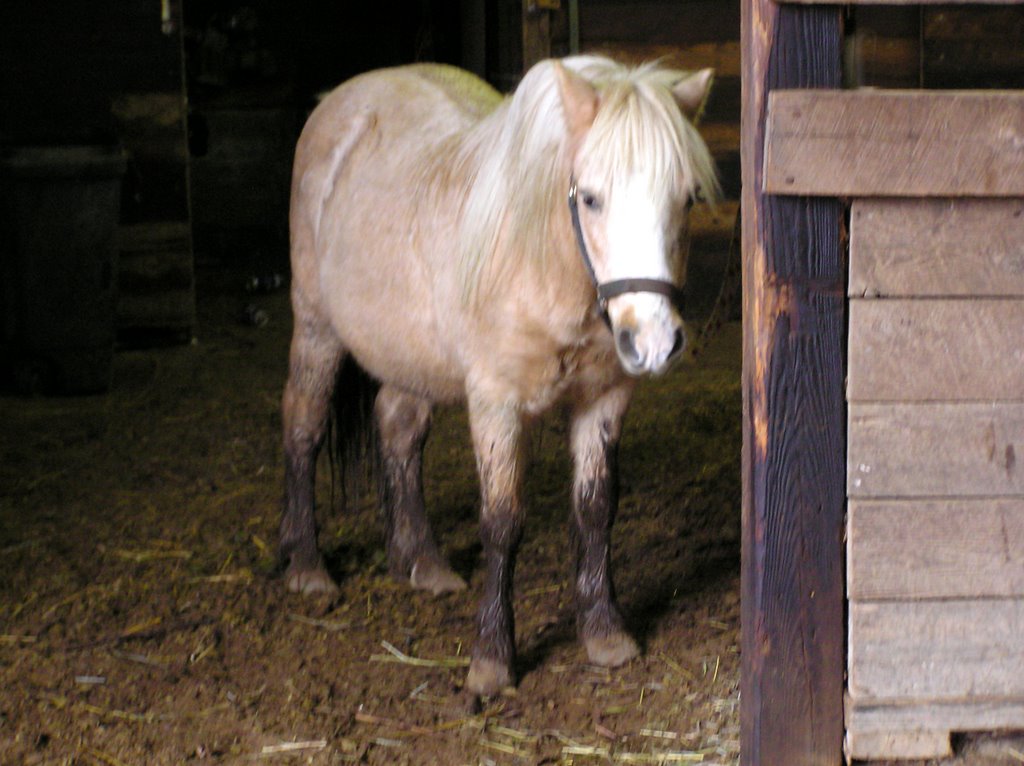
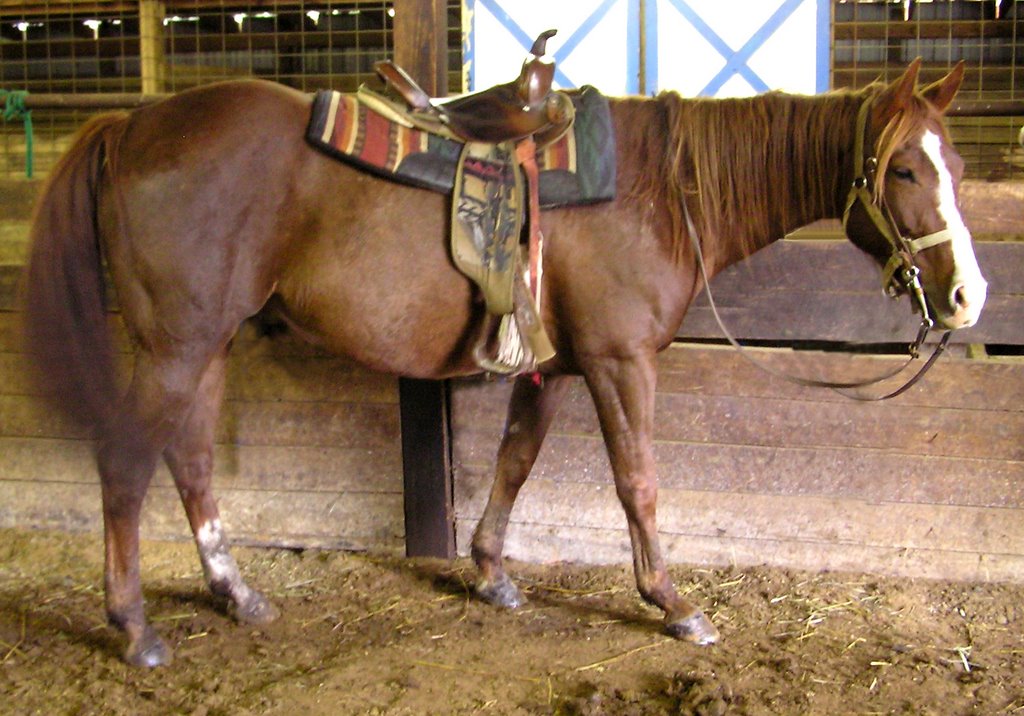
Last week, however, my friend Amy took me horseback riding at a local dude ranch and I was able to touch my fingertips to the dream again. My steed was Gordy, a mud-speckled chestnut (it had been raining for days) with a surprisingly pleasing personality for a dude-ranch horse. He had good brakes, a responsive accelerator and reasonably good steering. The Hallowe'en decorations didn't spook him, and when told to do something displeasing (take the path away from the barn, for example), he did so with minimal (but audible) grumbling. We got along just fine.

It was a grey, cool day, perfect for a ride through woods and along soybean fields. We saw several deer almost within touching distance, hens and their chicks scratching in the leaf litter of the woods, and quite a few chopped-up corpses. (The decorations were decidedly gruesome.)


The barn was occupied by a herd of very small ponies who milled around like feral cats. When we arrived, they had breached the tack room door and were busy scattering the contents of a garbage can, nosing around for edibles.

Other critters included a workmanlike cattle dog named Roper and a teacup poodle/Yorkshire terrier cross who resembled nothing more closely than a long-haired guinea pig. He rode around in his mistress' jacket, as one hoof put wrong would have squashed him like a bug.

Thanks, Amy, for reminding me that there is more to life than cooking and cleaning and supervising homework. I needed to touch my dream again.

Sunday, October 08, 2006

Blue Skies of October


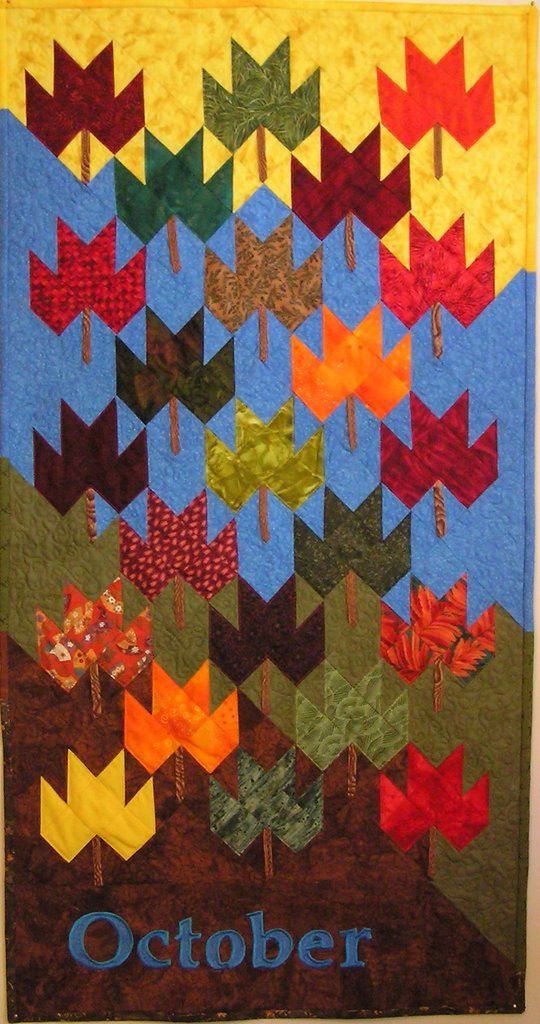
Last year, my local quilt store ran a monthly class making Joined at the Hip's Button-Up wall hangings. Button-Ups are 22" x 40" quilts that attach to a slightly larger quilted base with buttons and button loops. They're designed to let you switch wall hangings easily so you can put up new ones monthly, seasonally, or whenever you wish.

Although their primitive style isn't my favorite, I thought they'd be perfect for my grandmother, who can always use something to brighten her room at the nursing home.
I'm a fiddler, though, and can't leave a pattern alone. Nearly every month I've changed the pattern in some fashion, sometimes abandoning it altogether.

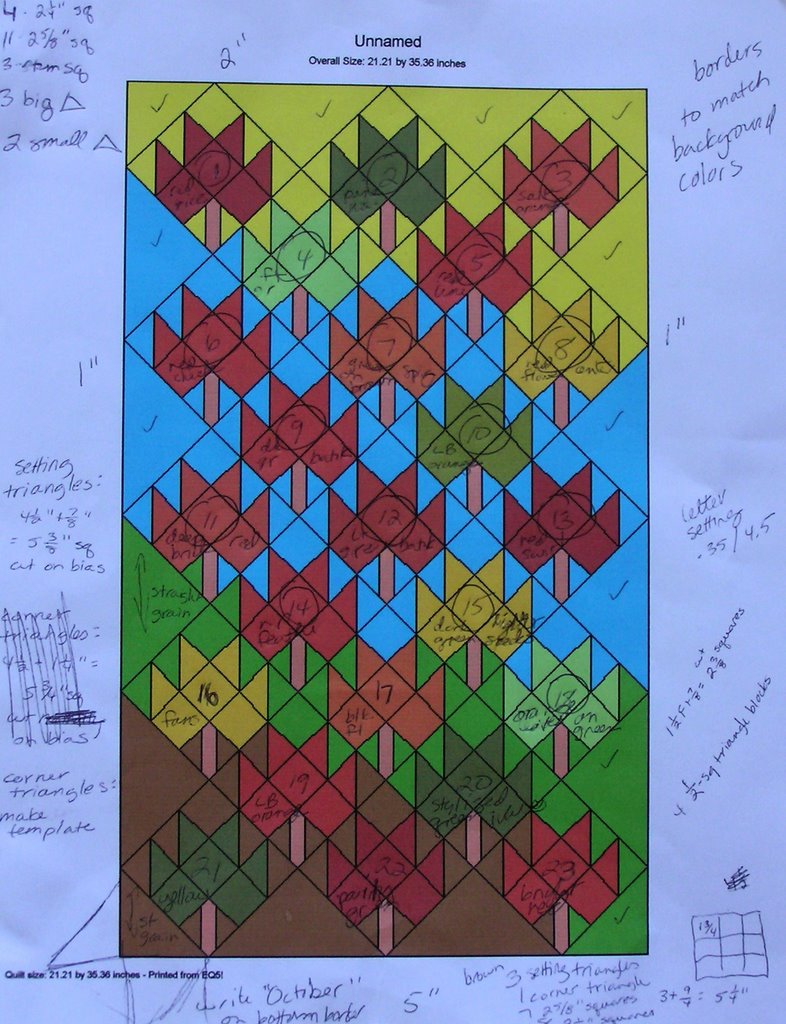
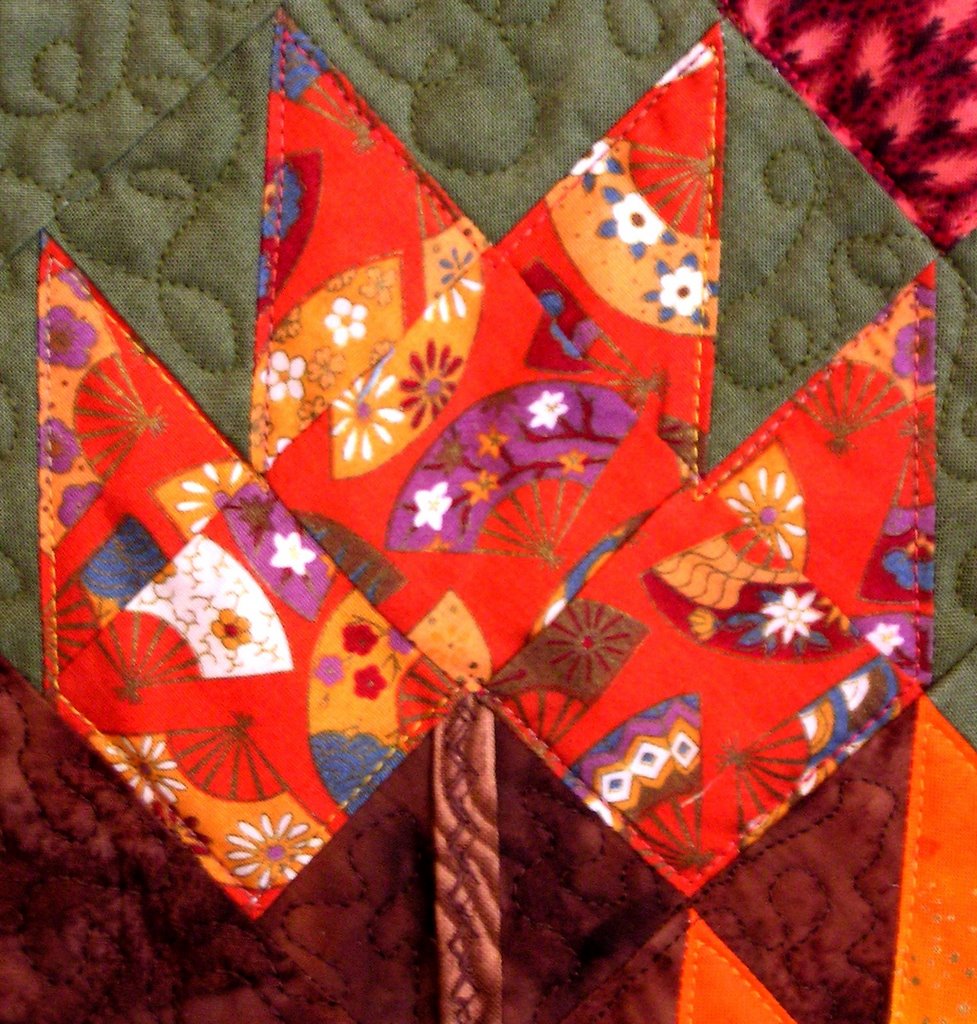
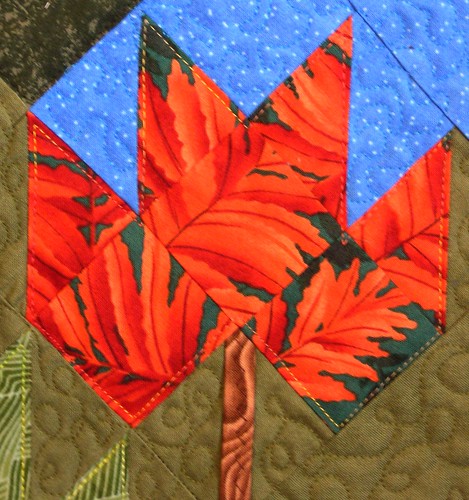
Their October is a Hallowe'en picture of a black cat and a pumpkin. It was nice, but I wanted fall leaves, so I fired up Electric Quilt and banged out a pattern.

Part of the fun (and an economic necessity) was working entirely from my stash. I particularly like the Japanese fan fabric:

and a fall leaf fabric that was fun to use in building a leaf block (a meta-leaf?):
Now I'm working on a November wall hanging. It's not going nearly as well, but we'll see if I can salvage it after a stupid miscalculation. (moral: always, always make a test block before cutting components for all the blocks. One never cuts the pieces too large.)

Sunday, October 01, 2006

Museum Worthy

My 11-year-old daughter loves to play with Photoshop. Here she took a little candy plane that my brother got at Osh Kosh, put it against a blue sky backdrop, and added little contrails. I don't have her skills, but it was fun uploading her picture to museumr, a fun little flickr toy which puts your photos in a museum setting. Wheee!

Thursday, September 28, 2006

The Smell

You know the smell. You catch a whiff of something . . . something not quite right. But you're on your way to another room, so you walk by and forget the smell. Later, you notice it again, and it is familiar but unsettling. "Can you smell that?" you ask your family. They sniff around, and some of them can smell it, and some of them can't. The family project evaporates in indecision.

A few days (or weeks) later, you walk by and there, there is the smell. It is more noticeable now, more disagreeable. It cannot be ignored. The phone rings, you're expecting a call; you forget the smell.

On a sunny, breezy day you open all the windows and air out the house. More days pass.

Later, puttering around the sewing room, you move a forgotten box and EEEEEEEwwwwwuuurgh, you find the source of the smell. Poor wee mousie. He is not so cute now.

Cleaning the sewing room becomes an all-day project. You find small caches of sunflower seeds, a few kibbles of dog food carefully hoarded behind a stack of books. And then, horrors, your special length of black sparkly fabric is enshrouded in fluff. Black sparkly fluff. It has become a glamorous mouse nest.

More horrors appear. By the end of the day there is a body count of three. They were all tiny babies -- sad for them, but lucky for you, because the body mass was small and the mess and smell, therefore, minimal. You recall the day your little cattle dog caught a mouse in the house. It was probably the mama.

But good has been done. The fabric stash has been sorted: this stack to wash and give away, that stack to wash and keep. Bits of uncompleted projects have been reunited, labeled, and packaged securely in tight-lidded boxes. Forgotten books are reviewed and remembered as sources of inspiration and delight. Childish art, now several years old, is rediscovered and treasured.

And you vow never to ignore that smell again.

p.s. Mom, I found the Civil War quilt blocks.

Monday, September 25, 2006

Unfortunate Cookies


I have heard of people making fortune cookies. I even seem to recall recipes for them, ones that never got off the ground in my kitchen because they called for "orange water." Eh?

But yesterday I found a simple recipe for fortune cookies in an old (May 2006) copy of Cooking Light magazine. I like fortune cookies. And these have no fat! No cholesterol! Only four ingredients! And no orange water! So I whipped up the batter and overlooked my misgivings.

First off, the batter tasted bad. With only bread flour (bread flour? tiny alarm bells in my brain began ringing.), sugar, egg whites, and vanilla, there's not much there to taste. It reminded me of the cardboard boxes that sweetened kids' cereal comes in. (Not that I've ever eaten the box, but I can imagine.)

While the batter rested in the fridge (and the brand new Pyrex measuring cup it was in exploded, necessitating a complete fridge clean-up and a quick check of the Pyrex website, which is neither here nor there), I had lots of fun looking up fortunes and fortune cookies on the web. Wikipedia, as usual, had the best information, which you can read here if you're interested. (Yes, I did make a second batch of batter.)

Making the cookies was a nightmare. (The Pyrex explosion should have been a warning to me.) Here's how:

Draw 3-inch circles on baking parchment (and can anybody find a protractor in this house? Seems like I buy one every year from the kids' list of required school supplies, but they never use them and the sneaky devices scuttle away on their pointy little legs to hide with all my good pens and scissors.)

Measure all your cups and glasses to find one with a 3-inch rim. Draw the circles. Then tape the parchment to the baking sheets.

What? Tape? In the oven? Are they nuts? No way am I cleaning baked-on glue from my cookware. Let the darned paper curl whatever way it wants. (And it does.)

Now measure a teaspoon of batter (that's a tiny little dab) and spread to cover the now alarmingly large 3-inch circles. It doesn't work. It won't spread that far. Try to hold the parchment steady while you do this. The parchment is now alive, and wiggles and crunches in its efforts to wave free.

Add more batter. Have a clue in your little head that the recipe author knows what she's talking about when she tells you to only bake three cookies at a time, and only cover three of the circles.

Figure out that adding more batter was the wrong thing to do when the cookies take 9 minutes to bake instead of 5.

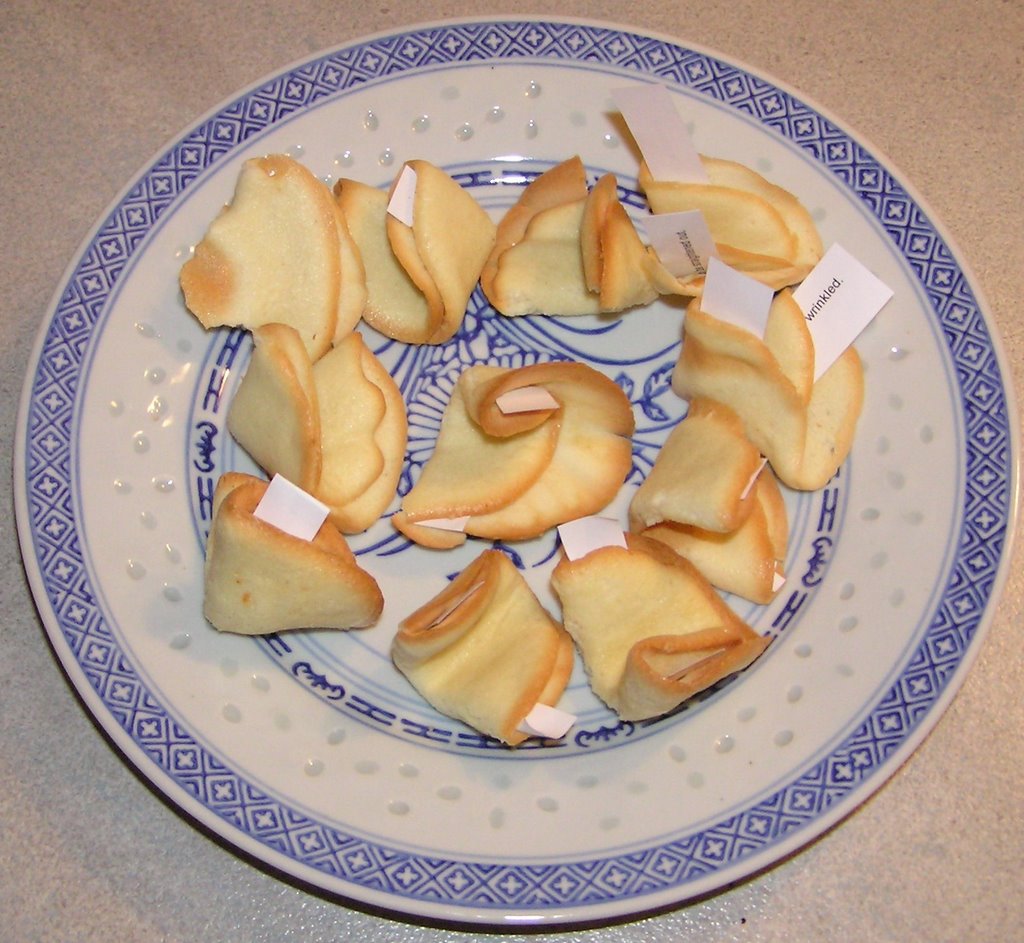
Scrape the cookies off the parchment, which has developed a powerful attraction to them, lay a fortune on each one, fold in half without breaking, then fold again over the edge of a bowl. The author mentions that you might have to hold the cookies in shape for a few moments while they set. Now these cookies, which were set enough to crack upon leaving the oven, now do not want to hold a crease. Hold the cookies for about half a minute before giving up.

(Spread, bake, scrape, fold) endlessly in this ridiculous baking project that you intended to do with your daughter, but you spared her the agony and let her play computer games instead.

Go down to the basement for a Chinese rice-grain plate and discover one dead mouse and one live one. Scream. When the family does not notice, scream repeatedly until they thunder down the stairs (it takes quite a few screams).

Place the few cookies that managed to fold more-or-less properly on said rice plate and take a picture for the blog.

Present cookies to family. Have them peer suspiciously at the pale blobs, take one nibble, and declare the cookies inedible.

Write family out of will.

I will not surrender to cookie misfortune. Obviously the planets were not aligned or something. Although I may wait some time before making another attempt. I don't want my house to explode.

Monday, September 18, 2006

Cooking the Books


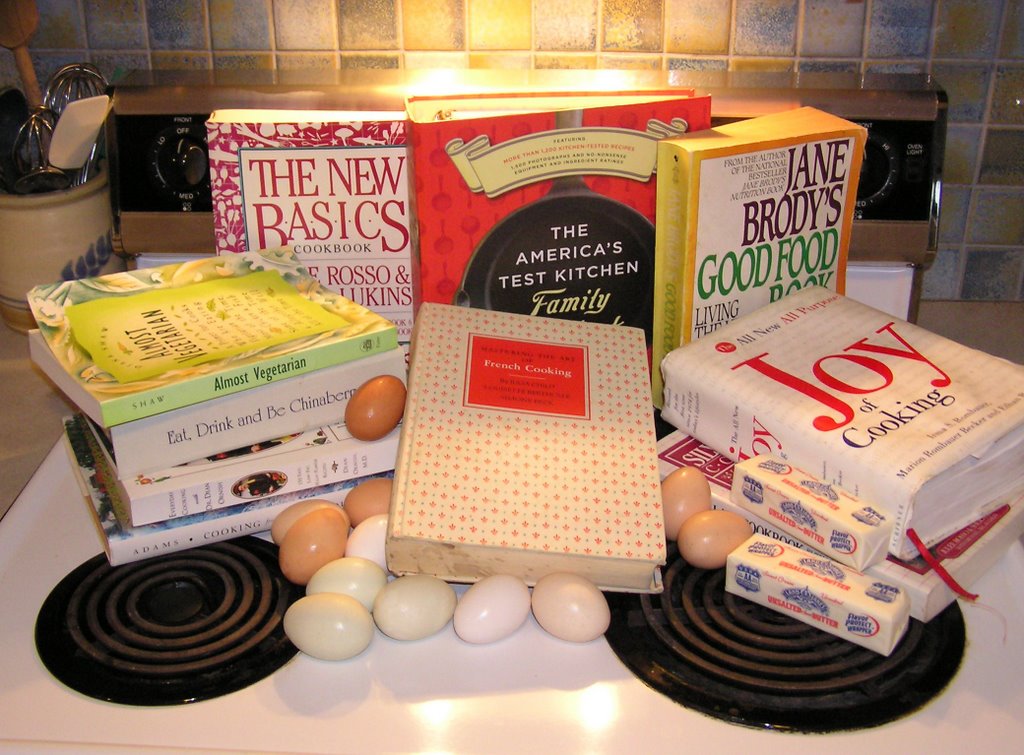
I want to be Julie Powell, who cooked her way through Julia Child's Mastering the Art of French Cooking in a year, blogged about it, and then wrote a book about her transformative experience. Unfortunately, my cholesterol levels are too high to attempt anything like traditional French cooking. And my admittedly conservative tastes (in food only, mind you) would rule out whole chapters on sweetbreads, shellfish, and anything with really icky ingredients.

Perhaps The America's Test Kitchen Family Cookbook? A behemoth captured in a 3-ring binder, this tome is clearly intended to supplant the old standard Betty Crocker in the kitchen (although I've always been a Joy of Cooking follower myself). I love this book. Christopher Kimball and his minions are the ultimate food geeks, and their fanatic recipe testing practically guarantees wonderful results. Of course, with more than 1,200 recipes, it would take me at least four years of dedicated cooking to make my way through the whole book. And the cholesterol? These people focus on taste, not butter limits. There would probably be a whole lot of nights where my family would enjoy all their tasty recipes while I broke out a can of beans to go with my plate of brown rice.

Diana Shaw's Almost Vegetarian might be a good bet. It has some chicken and fish and, while nowhere near vegan, utilizes fresh vegetables and other plant foods while stressing health and good taste. It has about 150 recipes. Doable. Very doable. But this isn't a tome, a classic, a milestone of cookbooks the way the others are. As good as it probably is (and Diana Shaw is a well-known and respected cook and writer), Almost Vegetarian doesn't have the oomph of the others.

Then again, I don't have the oomph of Julie Powell. What a woman. She managed to track down odd and sometimes out-of-date ingredients (bought a marrow bone recently, anyone?), follow lengthy and difficult instructions (boning a duck), and eat stuff I wouldn't even be able to contemplate (brains, lobster). Every day. For a year.

She cooked through a terrible job, September 11th, and the massive East Coast power outage (she lives in New York City). Not only did she eat this stuff every night, but she served it to friends and intimidating people.

In the end, what she did wasn't really about cooking a whole book, but more about transforming her life, finding meaning and joy in a time of personal and national torment. This is what awes me about Julie Powell. I wonder if the irritation Julia Child apparently showed over Julie's efforts was simply a misunderstanding of what she was really doing, or if Julia unconsciously recognized a force perhaps greater than her own in this somewhat bad-tempered New York secretary.

I'm probably not going to find Julie's courage or focus in the kitchen. A little bit of joy, though, would be good.

Monday, September 11, 2006

Trashy Traditions


It's my husband's birthday today -- he's one of those unfortunate souls who shares his day with a national tragedy. It does tend to drive home how lucky we are to be alive.

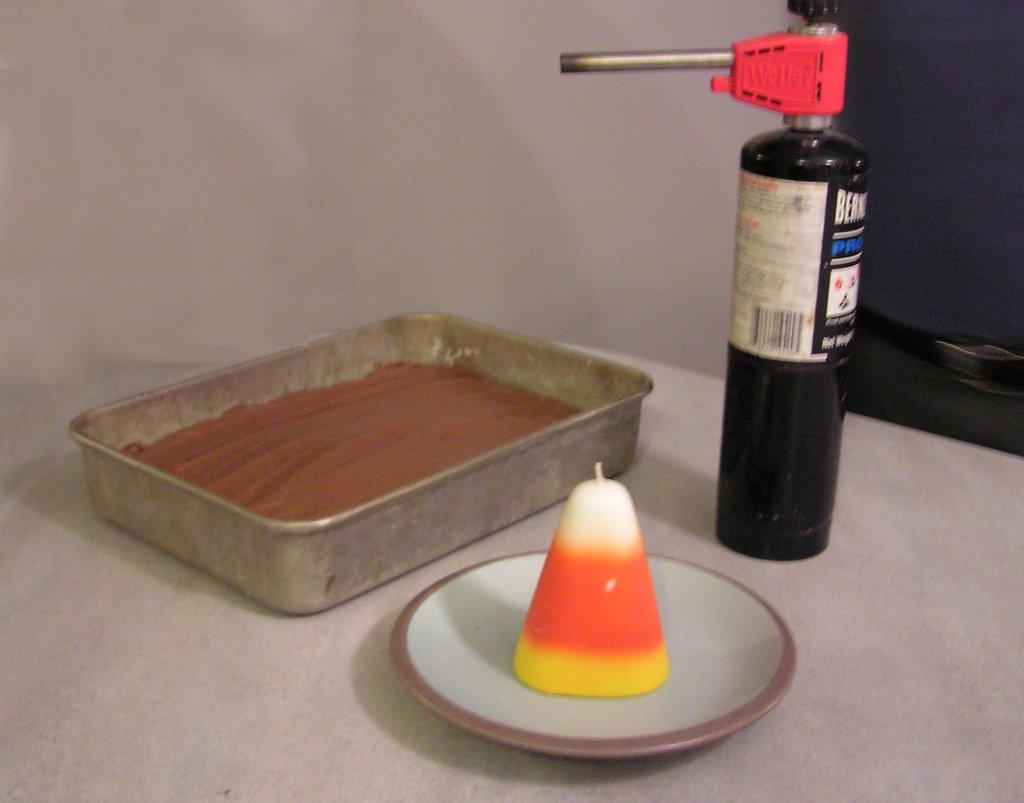
We celebrate in the traditional way, with cake and candles. Sort of. Not being organized folk, we never have matches when we need them. What we do have is a blowtorch. It has become our custom to light birthday cake candles with the blowtorch, in a sort of Red Green nod to home handiness.

And our lack of orderliness means that we're unexpectedly out of candles. Lucky I've been cleaning the basement, so I know where the Halloween candles are. Birthday tradition saved, and enhanced.

The cake upholds another trashy tradition, that of the store-bought box mix served straight out of the baking pan. I draw the line at canned frosting, however. It's gotta be homemade.

Friday, September 08, 2006

Middle School Madness


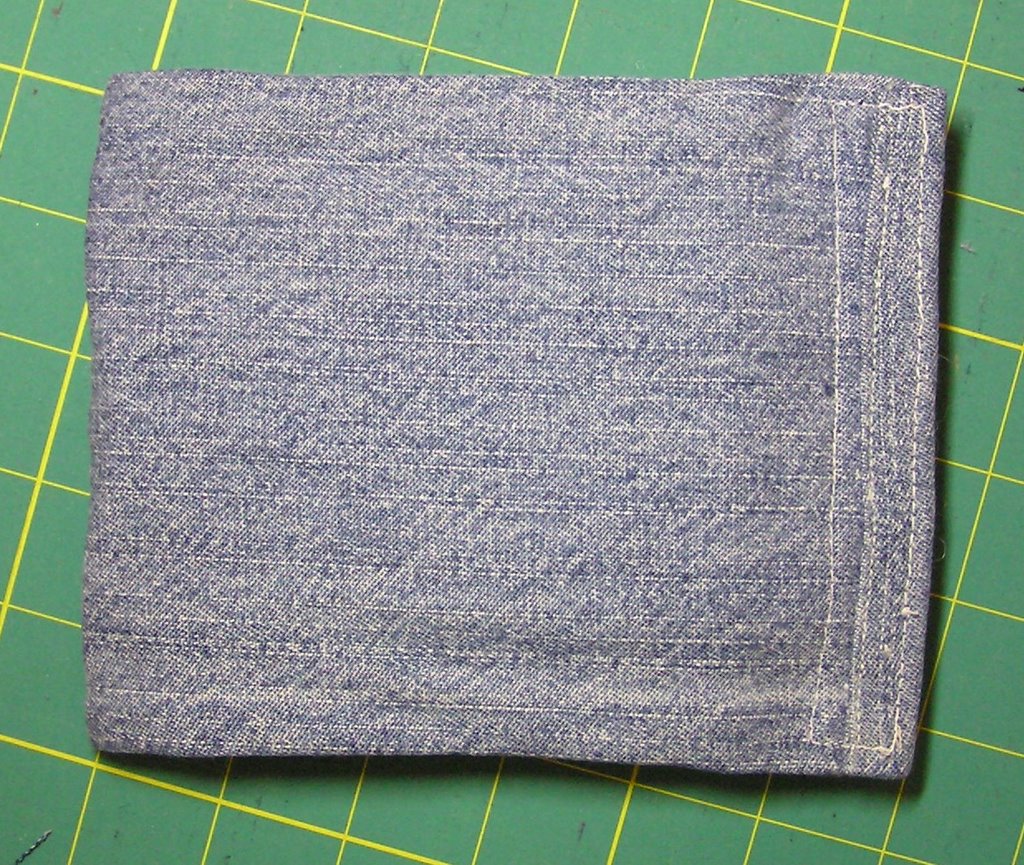
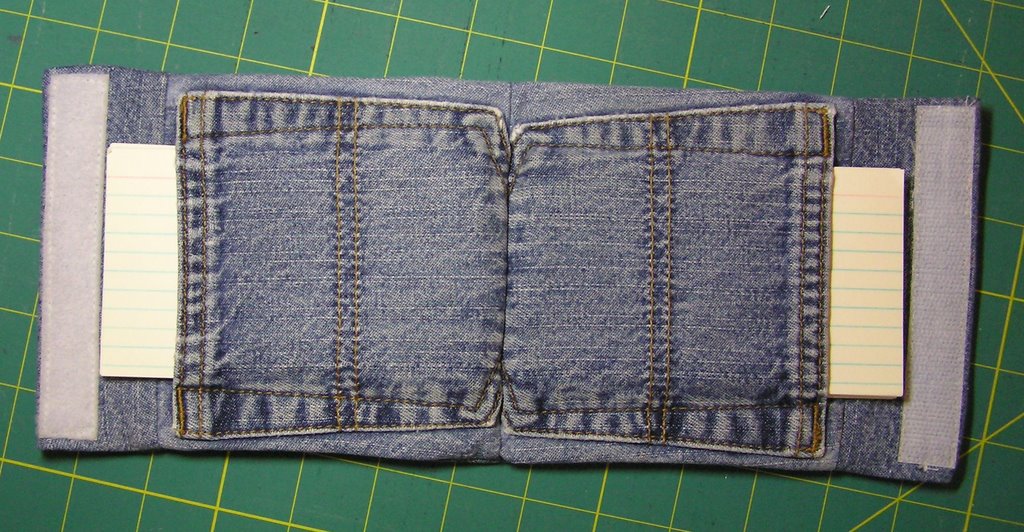
Index card wallet made from old jeans pockets and velcro -- my take on the school supply requirement for a box to hold note cards

Back to school and I'm up til the wee hours preparing every night. I'm not a student or a teacher. It ain't right.

Tonight I'm going to weigh my daughter's backpack. She can't lift it to her back; it would tip her over if she succeeded. She literally drags it into school. (We've ordered a wheeled backpack from L. L. Bean.) That a sixth-grader's school supplies should nearly outweigh her ain't right.

My son's math book has been trimmed and rebound for economy. This seems a sound practice: rather than trash the book, trim off the dirty edges and replace the scuffed cover. Its pages are extra-heavy for a long lifespan. Seems right. But the trimming process removed all the page numbers. Finding the assignment is difficult. Being sure he's on the right page is, well, nearly impossible. And how much did it cost to send the book to the cutter and rebinder? Did it travel far to get there? How much gas was used? After all, with those thick, glossy pages, the book weighs a ton (just ask my son -- or weigh his backpack). Would it be a better ecological as well as economic choice to print it more often on thinner pages and skip the rehab? I'm guessing yes. It ain't right.

Don't even ask about school lunch. The most popular choice at this middle school is the french fries with cheese sauce. Ooh, fried food with fatty cheese. Second choice? Candy and a pop. Yummy! All together, now: It ain't right.

Before I whine myself into an impenetrable cesspool of bitterness, I'd better think about what *is* right.

Gym classes are run with an emphasis on personal fitness. While team sports (with the dreaded team-picking and bench-warming) still form a large part of the curriculum, the kids also have fitness goals that include distance and timed running, sit-ups, and push-ups. I'm thrilled.

The teachers are young, energetic, and enthusiastic. Many are less than twice the age of their students. They're fresh from school themselves, with all sorts of teaching techniques they're eager to try on their students. I'm loving it.

And my kids come home smiling. They chose against the candy and pop for lunch. They've had some exercise. Their teachers have given them skills to practice and ideas to ponder. It's right.

Sunday, September 03, 2006

Ambrosia


In ancient mythology, Ambrosia (Greek αμβροσία) is sometimes the food, sometimes the drink, of the gods. The word has generally been derived from Greek a- ("not") and mbrotos ("mortal"); hence the food or drink of the immortals . . . . The classical scholar Arthur Woollgar Verrall, however, denied that there is any clear example in which the word ambrosios necessarily means immortal, and preferred to explain it as "fragrant," a sense which is always suitable. If so, the word may be derived from the Semitic MBR ("amber", which when burned is resinously fragrant; compare "ambergris") to which Eastern nations attribute miraculous properties. In Europe, honey-colored amber, sometimes far from its natural source, was already a grave gift in Neolithic times and was still worn in the 7th century CE as a talisman by druidic Frisians, though St. Eligius warned "No woman should presume to hang amber from her neck." [I think I'm going to make a practice of wearing amber from now on -- Anne.] W. H. Roscher thinks that both nectar and ambrosia were kinds of honey, in which case their power of conferring immortality would be due to the supposed healing and cleansing power of honey, which is in fact aseptic, and because fermented honey (mead) preceded wine as an entheogen in the Aegean world: the Great Goddess of Crete on some Minoan seals had a bee face: compare Merope and Melissa. See also Ichor. . . .

Derivatively, the word Ambrosia (neuter plural) was given to certain festivals in honour of Dionysus, probably because of the predominance of feasting in connection with them.
from wikipedia

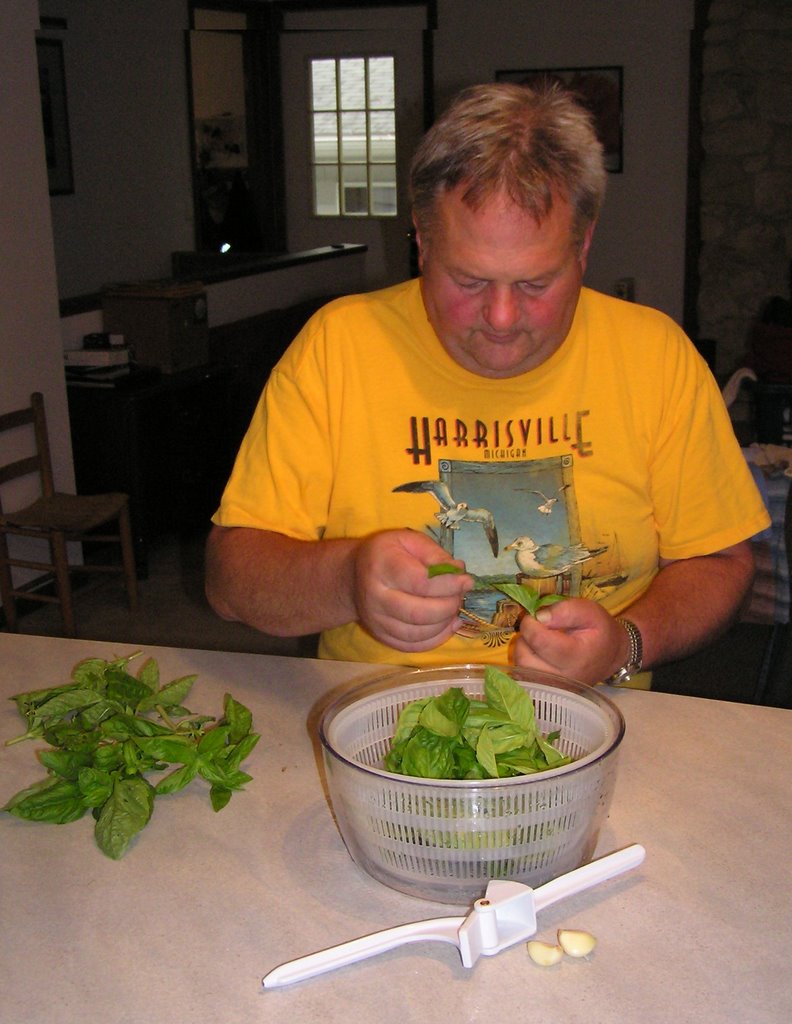
In summer, we feast on pesto. Basil is our fragrant food, so potent that I suppose it must have aseptic properties (and the garlic certainly does). Although we don't yet have a vegetable plot in our yard, we planted lots and lots of basil in pots on the deck. There is more than enough to make pesto on Saturdays and Sundays simply by pruning the plants. Pesto has the taste of summer to me. What could be more summery than masses of green leaves? And what better binder than Greek olive oil? Food of the gods, I dub thee pesto.

What puts me in mind of things Greek is the most marvelous book, The Lightning Thief by Rick Riordan. This is his first book for young adults. Part American Gods and part Harry Potter, The Lightning Thief follows the uneasy growth of a teen troubled with ADHD, dyslexia, and social problems, which stem from his mixed parentage: part human, part god. My 10-year-old daughter and 13-year-old son both devoured it as voraciously as I did, and it is somewhat rare for our tastes to agree to such an extent. This book is (groan with me here) pure ambrosia.

Monday, August 28, 2006

You Want Some of This? 'Cause I'm Not Sharing It.


The chipmunks at the lake house are getting bolder all the time. My mom took a picture of this fine fellow who decided to join her reading group on the front porch.

Of course when Emily, my fearless cattle-dog mouser comes to visit, the chipmunks will prove a bit scarcer.

Friday, August 25, 2006

The Only Vacation I Ever Get Is Virtual

Thank you, Owen, for this bit of fun. Thank you, Rum and Monkey, for publishing it on your blog. Thank you, Astrid, for including it on yours; and on yours, Poppalina, which is where I found it and which is always full of wacky fun and artistic inspiration.

I am Al-Aziziyah, Libya!
Which Extremity of the World Are You?
From the towering colossi at Rum and Monkey.

Wednesday, August 23, 2006

Blog Zen and the Art of Home Maintenance

It is far more amusing than it should be to make subtle variations in the design of this blog. Unfortunately, Blogger has temporarily taken away the ability to make changes in the xhtml code, so (after finally learning a bit of coding) I can't make some of the changes I'd like. We'll all just have to live with it. While my legions of fans (all one or two of you) may neither notice nor care, blog decorating is cheaper and easier than home decorating, so I'm disappointed.

Daughter M's room is the current focus. She chose the colors, and we painted the walls a soft medium blue with pale yellow trim. We remade her closet into a bed nook, painted soft green (no doors, of course) and are building a wardrobe into a corner of the room. A shelf will line the room a foot or so below the ceiling to hold a freize of stuffed animals (she has gobs of them). Photos as the work gets done.

We celebrated her birthday this week with a trip to Ikea. What a store! Lucky it's an hour away, or I would shop there far more than would be prudent. I love their simple styling, large selection, and low prices. "The Swedish K*Mart" is an apt description. I found the quality on some of the pieces a bit iffy, but most of it seemed sturdy and a good bargain. I can't wait to go again.

Sunday, August 20, 2006

Dividing the Daylilies


I've been invited to a friend's house to share our perennials. Instead of waiting till the last minute like I usually do, I've begun to dig the perennials several days in advance. This is so unlike me that I don't recognize myself in the mirror.

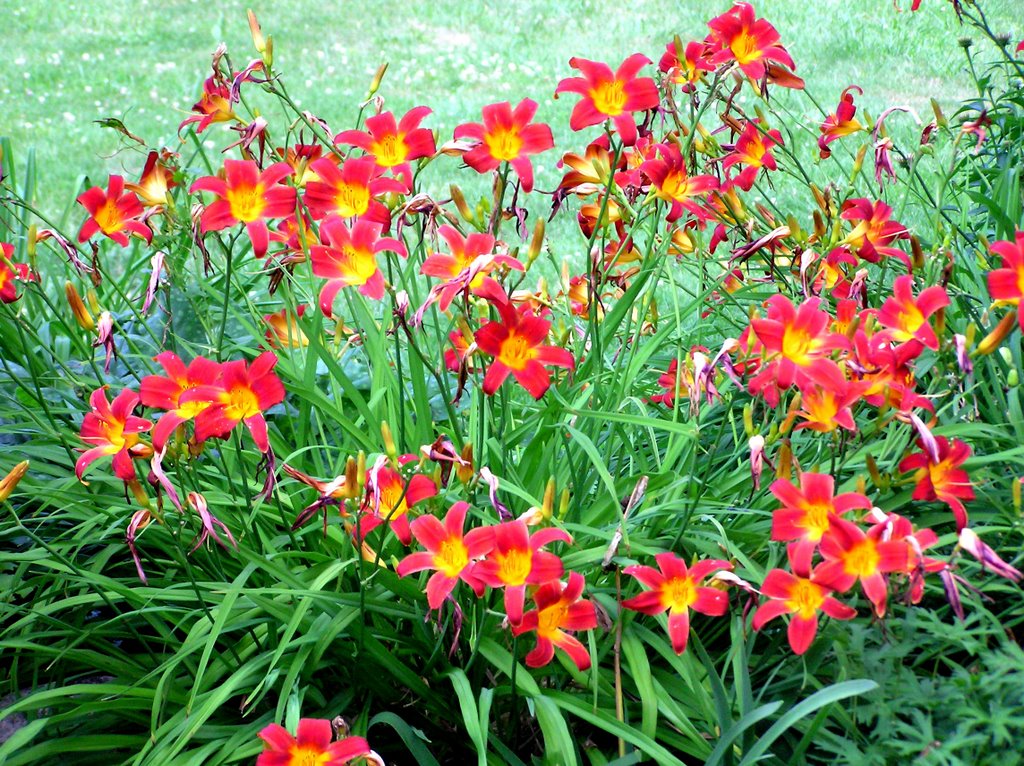
My gardens seem to specialize in red daylilies. I've got enormous clumps of them, all subtle variations on the theme of Red with a Yellow Throat. Out they go! Last spring I got rid of the dreaded Stella D'Oros (far too reminiscent of school-bus yellow), and with the reds gone, I can indulge my taste for clear yellows, peaches, and pastels.

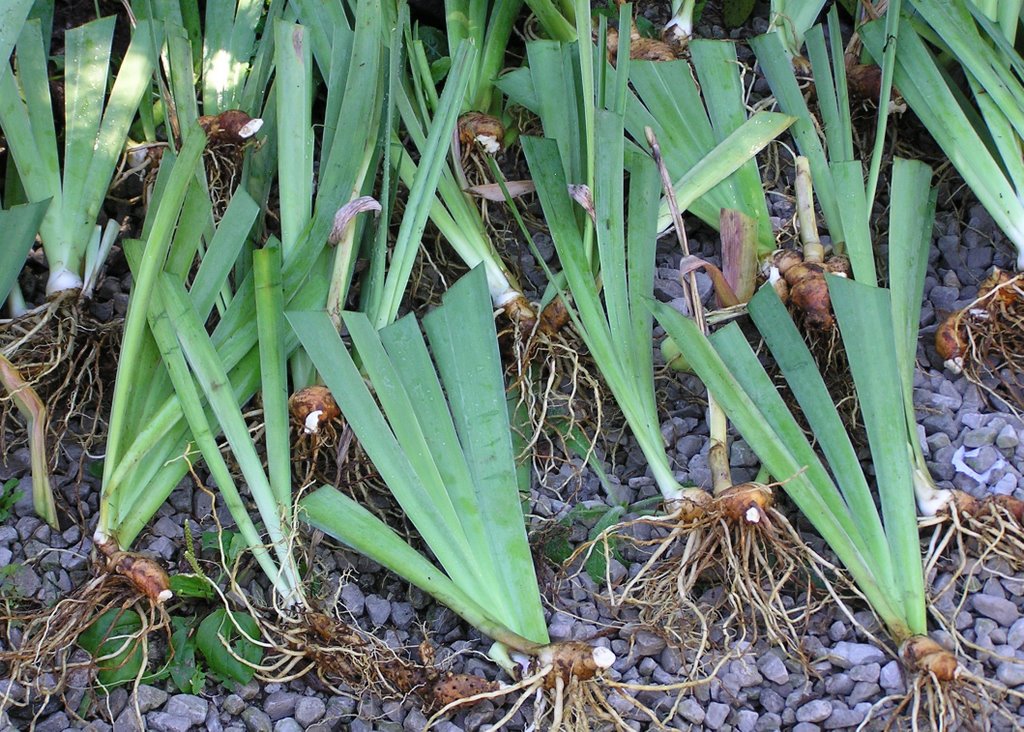
dug-up dayliliesIt's not that I don't like red flowers. I do. Red cannas are glorious. I've got lots of crocosmia 'Lucifer' scattered about, and they're staying. Red tulips? The ultimate. But my red daylilies are trying a bit too hard to be red; it doesn't sit well on them. I remember a quote from somewhere: "There are a million different colors of daylilies, and all of them are orange." Underneath the red of these ones is a strong orange gene pushing hard to get out. It makes for an edgy plant, and I don't need edgy in my garden.

My favorite daylily (well, right now it's my favorite, because it's about the only one blooming) is 'August Orange.' I got it from Bob Stewart's Arrowhead Alpines in Fowlerville. You have got to read this guy's catalog. Here are just two entries:

Heuchera 'Plum Pudding'
Purple foliage, my muse hates plum pudding, altogether too cute, I just want to gag, how can I write a description about plum pudding; no, we will have no Dickens–Christmas Carol sickly sweet prose here.

Heuchera 'Yeti'
The Abominable Heuchera, this nearly ate Sir Edmund Hillary in the western Himalaya in 1958, no wait I’m confused that was a crappy Heuchera we bought out of tissue culture that looked nothing like the photo. Hmm, that’s not quite right either this yeti is a good looking white flowered plant with nicely marbled leaves, it will enchant your garden causing fox tracks in the snow to magically sublime into yeti tracks and creating no end of panic when the local tv station runs the tape.


He is some kind of whacko, and I wish we could be best friends. Arrowhead carries rock garden and difficult-to-find plants as well as (against his will, I think) more marketable varieties. Many of them are very tricky to grow, which he freely admits. To use his parlance, I've croaked a bunch of them.


But 'August Orange' is sublime: a bright orange-yellow like a candle flame. It blooms profusely throughout August and September, continuing through October and with a few scattered blooms (sans foliage) right into late November. The plant looks like hell by then, to be sure, but I won't argue against anything that blooms so late in arctic Michigan.

I also dug up a big mass of irises. Their corms (I think they're corms, not rhizomes or tubers) were so layered and tangled amongst themselves that I had to work at them with a garden fork and hose for quite some time before I could tease them apart. This is such satisfying work to me. I can't wait to go back out and replant some of them back into their refreshed bed.

Sunday, August 13, 2006

Up North

There's a lot of talk about "up north."
It's the place everyone seems to want to go
to escape the pressures and frantic pace of everyday life.
But where is "up north"?
For "up north" is not so much a location as it is a state of mind.
So, how do you know when you've arrived "up north"?
When you feel the cares of the world begin to slip away . . .
When you find yourself breathing a little deeper
because the air seems purer somehow . . .
When you notice that the sky is bluer, the pines are taller
and the people smile a lot more . . .
It's then that you know you're up north!

--Suzanne Kindler


My mom has a watercolor of pines and a lake in her house on the shores of Lake Huron. On it is this poem in calligraphy that swirls like mist through the trees. It is a rather ordinary poem, without particularly poetic language or subtle meaning. And Up North is a common, ordinary concept, familiar to anyone in the midwestern United States. Lower Michiganders go Up North, either to the thumb, or higher up the mitten, or even across the bridge to the Upper Peninsula. Minnesotans have their Up North lake country, New Englanders have the Maine coast and woods, Massachusetts has the Cape. I suppose northern California is an escape to those who live in the more populated south. Are the Rocky Mountains another kind of Up North to the people in the western plains states?

My Up North is a stretch of woods on the shore of Lake Huron. The coastline forms a cove about 5 miles long. For a good long stretch, maybe a mile and a half, it's fairly rare to see more than a handful of people on even the brightest summer day.

The lake is a huge presence. Its waves crash or whisper ceaselessly, forming a silvery aural backdrop to daily life. Is that why the regular chores of cooking and cleaning seem so trivial here? At home, the household chores are a grind. The dirty laundry piles up faster than I can run it through the washer and dryer. I can't sort the fresh clothes into their closets and drawers before the laundry heap towers by the machines again. And the kitchen is never clean. Before breakfast, the late-night snacks must be cleaned up. Breakfast, lunch, dinner, dessert, plus constant snacking by the kids ensures a neverending state of sticky counters and a sinkful of dishes. Cleaning the floor is a horrendous task that hangs over my head, for it, too, seems to attract a steady buildup of dirt and debris. It is too much. My home demands my life as sacrifice if it is to remain even marginally clean and uncluttered and with food on the table at appropriate times.

But up north, a sandy floor is quickly swept, and mom and I can whip up meals, and clean up after them, without planning our day around them. These things are trivial, mere interruptions in long days full of beachwalking, kayaking, gardening, reading, sewing, painting, and just plain living.

And the kids aren't glued to computers and video games for hours and hours, as they are at home. Granted, they do get a video fix. Here at Grandma and Grandpa's, they watch cartoons on TV when they need a break from the sun or for half an hour before a meal. But most of their time is spent playing in the sand and water.

I love up north. I hope you have one, too.

Tuesday, August 08, 2006

Calling Into Question

A post on Wendy's blog today brought back my previous life as a grad student of literature. She commented on students' overuse of the pretentious phrase, "as it were," in their speech. Back in my day, the phrase of choice was "call into question." "Doesn't Foucault's use of the prison icon paradigmatically call into question the predominant theory of Baudrillard's metasequoical randomness?" one would ask, parenthetically of course. No arguing with that. (Extra points for bringing Baudrillard into the nonsense.) Theory was the hot approach -- the right theory, of course. Deconstructionism was in the past. Post- deconstructionism (anything is better if you toss "post" in front of it) was better, if not exactly up to the minute. The meaning of literature (and, of course, "meaning" itself was called into question) was only worth talking about if it was a political discourse on the inequity of the blah, blah, blah -- I usually dropped off about here.

It's not as if I weren't interested in studying inequalities in literature. I was as critical of the white-male-dominated canon as anyone else and have a distinctly feminist viewpoint when approaching any literary piece (and by literary, I mean anything written). I'm probably more left-leaning, politically, than anyone I know, and my circle includes a whole host of left-of-democratic granola-crunchers. I am the proud owner of Birkenstock sandals. (Well, knock-off Birkenstocks. I'm cheap.)

But what I'm getting at here (yes, Virginia, there is a point) is that these well-meaning students were, in the end, poseurs. It didn't take any deep thought to call something into question. Zefrank noted just a few days ago that you can put down any argument with, "Well, it's more complicated than that." It makes you sound knowledgeable without actually adding anything to the discussion. Calling something into question achieves the same end.

And when a nationally-known and controversial speaker came to campus, these students boycotted her. They urged their students not to attend, and sat outside the lecture hall, encouraging people to go away. When I questioned their own political correctness in refusing to listen to another point of view, furthermore telling other people not to listen to it, they looked at me like I had two heads. I didn't get it. Simply listening to her was falling under the influence of the dominant paradigm. We couldn't be trusted to critically examine her arguments.

I remember an amusing incident one slow day down in the bowels of the grad students' basement offices. There was an old sports magazine lying around with a picture of a college-age woman in a bikini. My friends and I, tired of grading papers, were flipping through the magazine. "Huh," I said. "She has really big boobs." (And she really did. Either she had one heck of a plastic surgeon, or she was substantially endowed.) One of the sharky grad students came in just then, examined the picture, and chuckled. "We examine things on such different levels," he said. "What I see is how she is being forced to agree with the dominant paradigm of female sexuality." Oh, really? That was your first thought?

I left grad school, though not because of that incident. I got married, then pregnant with our first child, thus submitting to the ultimate expression of the dominant paradigm of my female sexuality.

Monday, August 07, 2006

Reflections


Reflections
Originally uploaded by lab.m0nkey.
I don't know if it's the colors, the reflections, the smoothness of the glass, the texture of the cement, or the contrast of sharp and soft focus, but this picture has real appeal.